
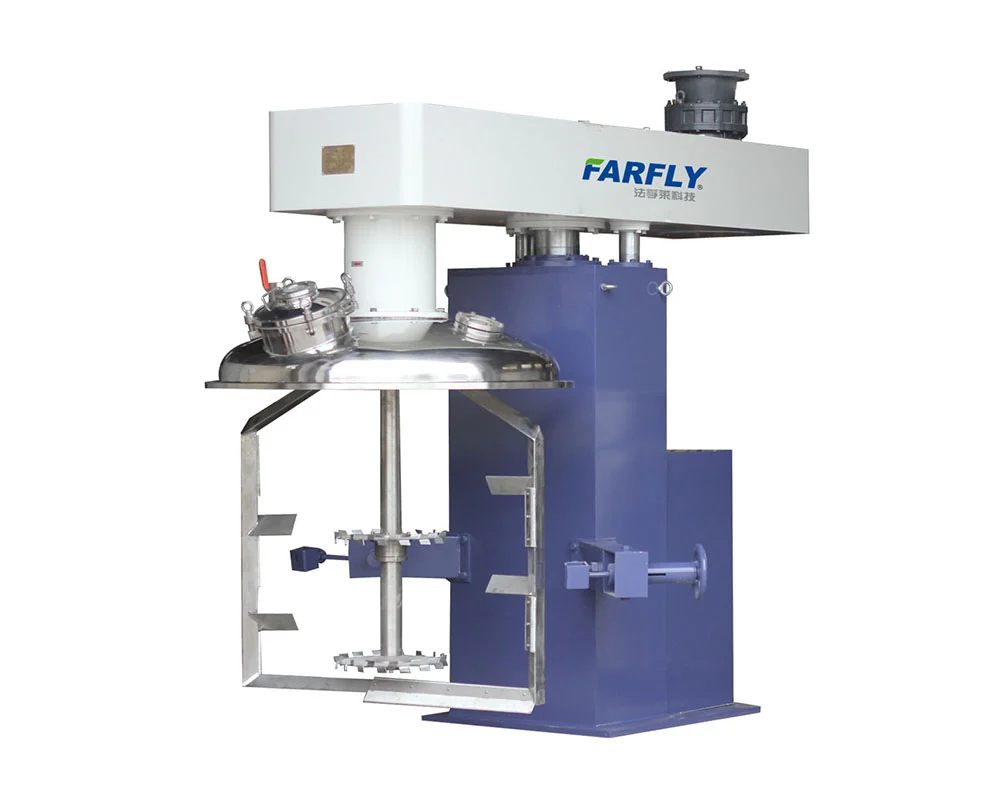
FDT Concentric Double Shaft Agitator

High-efficiency dispersing and mixing equipment developed for adhesive and high-solid-content formulations. The FDT combines a low-speed scraper agitator with a high-speed disperser in one vessel to support material circulation, wall scraping and intensive dispersion during the same batch.
Concentric low-speed mixing + high-speed dispersion
Typical viscosity up to 100,000 cps
Standard tank capacity 150–1500 L
Vacuum, hydraulic lift & variable-speed options
Mixing Principle
Scraping + Dispersion
Two mixing actions in one vessel
Typical Viscosity
Up to 100,000 cps
Subject to formulation and solids loading
Tank Capacity
150–1500 L
Five standard FDT models listed below
Process Options
Vacuum / Variable Speed
Hydraulic lift & swing available
Mixing Principle

How Does the FDT Concentric Double Shaft Agitator Work?

High-solid and viscous formulations often need two different mixing actions. The overall batch must continue moving through the vessel while powders, fillers and agglomerates are exposed to stronger local shear.

The FDT combines a low-speed scraper agitator with a high-speed disperser. The outer scraping action promotes bulk circulation and removes material from the vessel wall, while the high-speed dispersing disc works in the central mixing zone to accelerate wetting, dispersion and homogenization.

The concentric double-shaft arrangement combines macro-level material turnover with localized high-speed dispersion, helping process formulations that are difficult to handle with a single mixing action.
Two Functions Working Together The low-speed and high-speed mixing actions perform different roles during the same batch.
01

Low-Speed Scraper Agitator

Promotes overall material circulation and continuously returns wall-adhering material to the active mixing zone through PTFE scraping action.

02

High-Speed Disperser

Generates strong shear around the dispersing disc to break down agglomerates, incorporate powders and fillers, and improve dispersion uniformity.

Machine Design

Key Design Features of the FDT Agitator

The FDT is built around a configurable low-speed agitator, high-speed dispersing system and stable lifting structure. Agitator type, dispersing disc and drive mode can be selected around viscosity, density and formulation behavior.
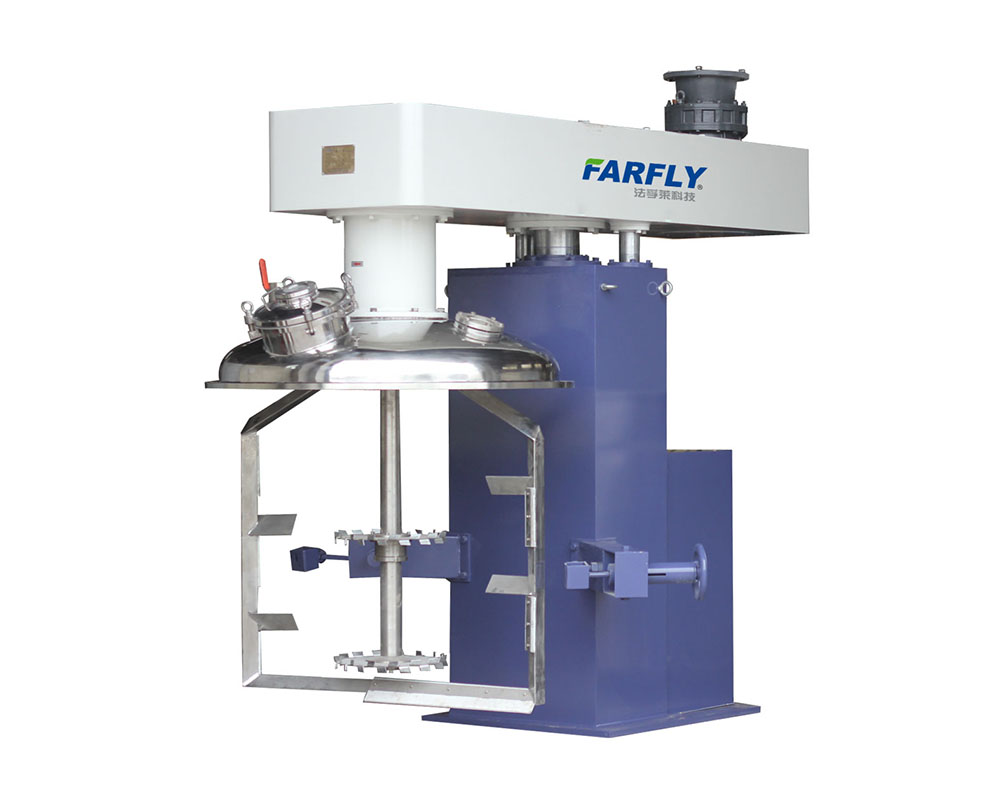
FDT concentric double shaft agitator machine structure
01
Frame / Half-Frame Agitator Low-speed agitator configuration can be selected according to material flow behavior and the required bulk turnover.
02
High-Speed Dispersing Disc Single-disc, double-disc and Neumann disc configurations are available for different dispersion requirements.
03
PTFE Wall Scraper Works close to the precision-turned and mirror-polished vessel wall to continuously remove adhering material during mixing.
04
Hydraulic Lift & Swing Supports lifting and swinging operation for vessel access and production layouts using a single tank or multiple tanks.
05
Fixed or Variable-Speed Drive Fixed-speed or frequency-inverter-driven variable-speed operation can be selected according to the process requirement.
06
Heavy-Duty Base Structure A large-area bed plate can be buried and bolt-fixed to provide stable support while maintaining access for disassembly and cleaning.
Applications & Process Fit

Suitable Materials & Processing Conditions

The FDT is designed for formulations that benefit from simultaneous wall scraping, bulk circulation and high-speed dispersion. It is especially relevant where higher viscosity or solids loading makes a single mixing action less effective.

01 / ADHESIVES

Epoxy Adhesives

Supports circulation and dispersion of resin systems containing fillers, powders and functional additives.

02 / ADHESIVES

Polyurethane Adhesives

Suitable for formulations requiring controlled mixing, wall scraping and optional vacuum processing.

03 / ADHESIVES

Anaerobic Adhesives

Helps combine liquid components and solid thickening materials while supporting consistent distribution through the batch.

04 / SEALANTS

Sealants

Suitable for viscous and filled sealant systems requiring simultaneous material turnover and high-speed dispersion.

05 / COATINGS & INKS

Coatings & Printing Inks

Applicable to pigment- and filler-containing systems where circulation and dispersion need to occur in the same vessel.

06 / HIGH SOLIDS

Wall Putty & High-Solid Compounds

Designed for high-solid-content formulations where wall adhesion and reduced natural circulation can become process limitations.

Especially Suitable When Your Process Involves Process behavior is more useful than industry name alone when evaluating mixer fit.
01 Viscosity up to the stated 100,000 cps range
02 High solids or significant powder / filler loading
03 Material tending to adhere to the vessel wall
04 Simultaneous circulation and high-speed dispersion
05 Vacuum deaeration or closed-process requirements
06 Single- or multi-tank production layouts
Mixer Selection Logic

When Should You Choose an FDT Concentric Double Shaft Agitator?

The FDT is most useful when the process needs wall scraping, overall material turnover and stronger local dispersion at the same time rather than relying on one shaft to perform every mixing function.

01

High-Solid Mixing Needs Stronger Turnover

The low-speed frame or half-frame agitator keeps the bulk material moving while the high-speed disperser works on powders, fillers and agglomerates.

02

Wall Adhesion Is Affecting Mixing Uniformity

The PTFE scraper continuously returns material from the vessel wall to the active mixing zone, reducing stagnant wall layers during processing.

03

Your Process Needs Flexible Dispersion Control

Frame style, dispersing disc, fixed or variable-speed drive and vacuum operation can be selected around the formulation and required mixing result.

Outside the stated FDT operating range? If the material has extremely limited flow or requires a different mixing mechanism, the process should be evaluated separately before equipment selection.
Technical Data

FDT Concentric Double Shaft Agitator Technical Specifications

Standard model data provides a starting point for equipment selection. Final configuration should be confirmed according to viscosity, density, solids loading, batch size and the required mixing or dispersion result.

Parameter / Model FDT-150 FDT-300 FDT-500 FDT-1000 FDT-1500
Tank Capacity 150 L 300 L 500 L 1000 L 1500 L
Mixer Motor 4 kW 5.5 kW 7.5 kW 11 kW 15 kW
Mixer Speed 50 rpm 40 rpm 25 rpm 25 rpm 25 rpm
Dissolver Motor 11 kW 15 kW 22 kW 37 kW 55 kW
Dissolver Speed 1500 rpm 1500 rpm 1500 rpm 1500 rpm 1500 rpm

* Specifications above are standard reference data from FARFLY. Final equipment configuration should be confirmed against the actual formulation and process requirement.

Configuration Options

Available FDT Agitator Configurations

The FDT can be configured around material viscosity, formulation behavior, dispersion target and vessel-handling requirements rather than relying on one fixed mixing arrangement.

Component Available Configuration Selection Basis
Low-Speed Agitator Frame / Half-Frame Selected according to viscosity, fluidity and required bulk turnover.
Dispersing Disc Single / Double / Neumann Matched to powder wetting, agglomerate breakup and dispersion requirements.
Speed Control Fixed / Variable Frequency Selected according to the desired operating flexibility and shear control.
Wall Scraper PTFE Scraper Continuously returns wall-adhering material to the active mixing zone.
Vacuum Process Available on Request Used when deaeration or reduced air incorporation is required.
Hydraulic System Lift + Swing Supports tank access and production layouts using one or multiple vessels.
Tank Arrangement Single / Multiple Tanks Selected according to batch handling and production rhythm.
Typical Process

Typical FDT Mixing & Dispersion Workflow

The exact sequence depends on the formulation, but a typical adhesive or high-solid batch may move through the following stages.

01
Material Loading Liquid components and selected raw materials are charged into the vessel.
02
Bulk Circulation The low-speed agitator establishes turnover and begins wall scraping.
03
High-Speed Dispersion The dispersing disc applies stronger shear for powders, fillers and agglomerates.
04
Controlled Mixing Both actions continue together; vacuum can be applied when required by the process.
05
Discharge / Transfer The finished batch moves to the next production stage according to the process layout.

Actual sequence, speed setting and process time depend on formulation, solids loading, viscosity and required final properties.

Mixer Selection

What We Need to Select Your FDT Agitator

Tank capacity alone is not enough to select the correct FDT model. Material behavior, solids loading and dispersion objectives should be considered together before the final drive and agitator configuration is confirmed.

Material Viscosity Provide starting, processing and expected final viscosity when available.
Batch Capacity Specify the required working volume or batch weight rather than only vessel size.
Material Density Density helps evaluate batch load and the required equipment configuration.
Solid / Filler Loading High solids can change material flow, circulation behavior and drive demand.
Dispersion Requirement Define whether the process needs simple incorporation, intensive dispersion or both.
Vacuum Requirement Confirm whether deaeration or reduced air incorporation is needed during processing.
Tank Handling Confirm whether the layout uses a single vessel or requires multi-tank operation.
Engineering Support

Configure the FDT Around Your Production Process

FARFLY can evaluate the FDT configuration around formulation behavior and production needs, from agitator and dispersing disc selection to speed control, vacuum and vessel handling.

01

Formulation Review

Viscosity, density, solids loading and material behavior provide the starting point for equipment selection.

02

Agitator Selection

Frame or half-frame mixing can be matched to the required bulk circulation and material turnover.

03

Dispersion Selection

Single, double or Neumann dispersing discs can be evaluated against the required dispersion result.

04

Process Control

Fixed or variable-speed operation and optional vacuum can be selected around the production requirement.

05

Tank Handling

Hydraulic lift and swing support single- or multi-tank production layouts and easier vessel access.

FAQ

FDT Concentric Double Shaft Agitator FAQ

Common questions when evaluating the FDT for adhesives, coatings, inks, sealants and other viscous or high-solid formulations.
What is an FDT concentric double shaft agitator?
The FDT is a dispersing and mixing system that combines a low-speed scraper agitator with a high-speed disperser in one vessel. The two mixing actions work together to provide bulk circulation, wall scraping and localized high-shear dispersion.
What viscosity can the FDT handle?
FARFLY lists the FDT for materials with viscosity up to approximately 100,000 cps. Actual suitability still depends on formulation, density, solids loading, batch size and the required mixing result.
What tank capacities are available?
The standard FDT range shown by FARFLY includes 150 L, 300 L, 500 L, 1000 L and 1500 L tank capacities.
What is the difference between the low-speed agitator and high-speed disperser?
The low-speed agitator is used for overall material turnover and wall scraping, while the high-speed disperser generates stronger local shear for powder wetting, agglomerate breakup and dispersion.
What agitator and dispersing disc options are available?
FARFLY lists frame and half-frame low-speed agitators. The dispersing disc can be configured as a single-disc, double-disc or Neumann-type arrangement according to the process requirement.
Can the FDT operate under vacuum?
Yes. Vacuum dispersing or mixing is available on request and should be selected according to the formulation and deaeration requirement.
Can one FDT agitator work with multiple tanks?
The FDT supports hydraulic lifting and swinging mechanisms that can be configured for production layouts using a single tank or multiple tanks.
How do I choose the correct FDT model?
Start with working batch capacity, viscosity, density, solids or filler loading, dispersion requirement, vacuum requirement and tank-handling arrangement. These inputs can then be used to evaluate the appropriate motor power and mixer configuration.
Scroll to Top

Get A Free Quote Now !

Contact Form Demo
If you have any questions, please do not hesitate to contact us.