How Does the FDT Concentric Double Shaft Agitator Work?
High-solid and viscous formulations often need two different mixing actions. The overall batch must continue moving through the vessel while powders, fillers and agglomerates are exposed to stronger local shear.
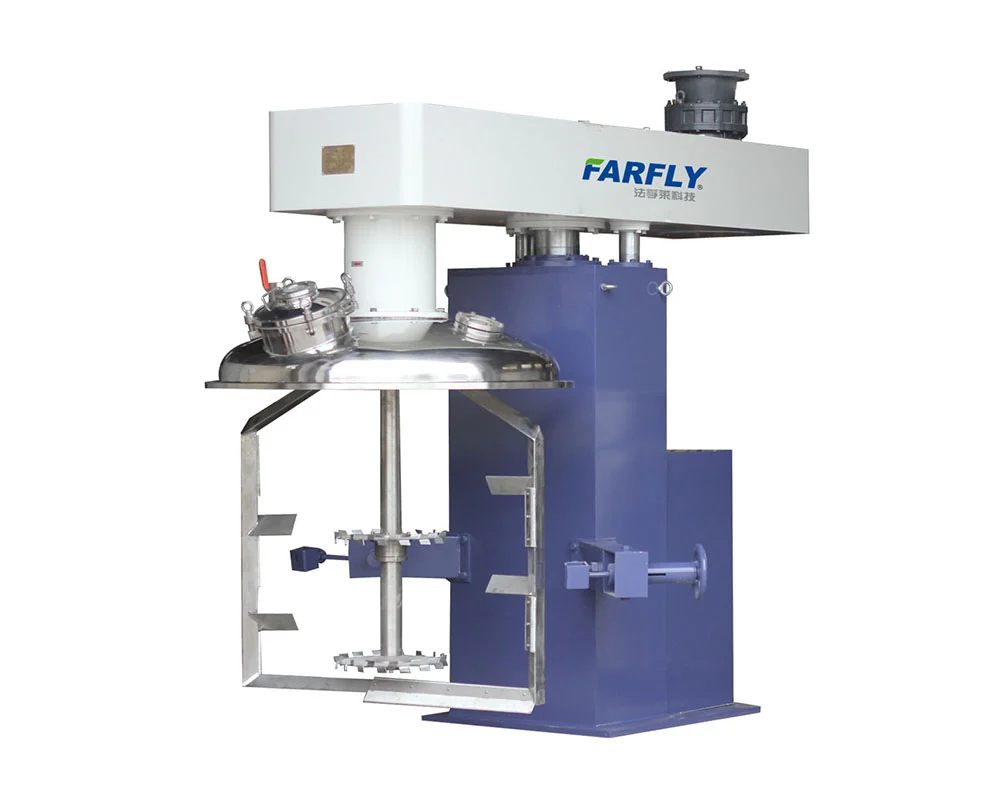
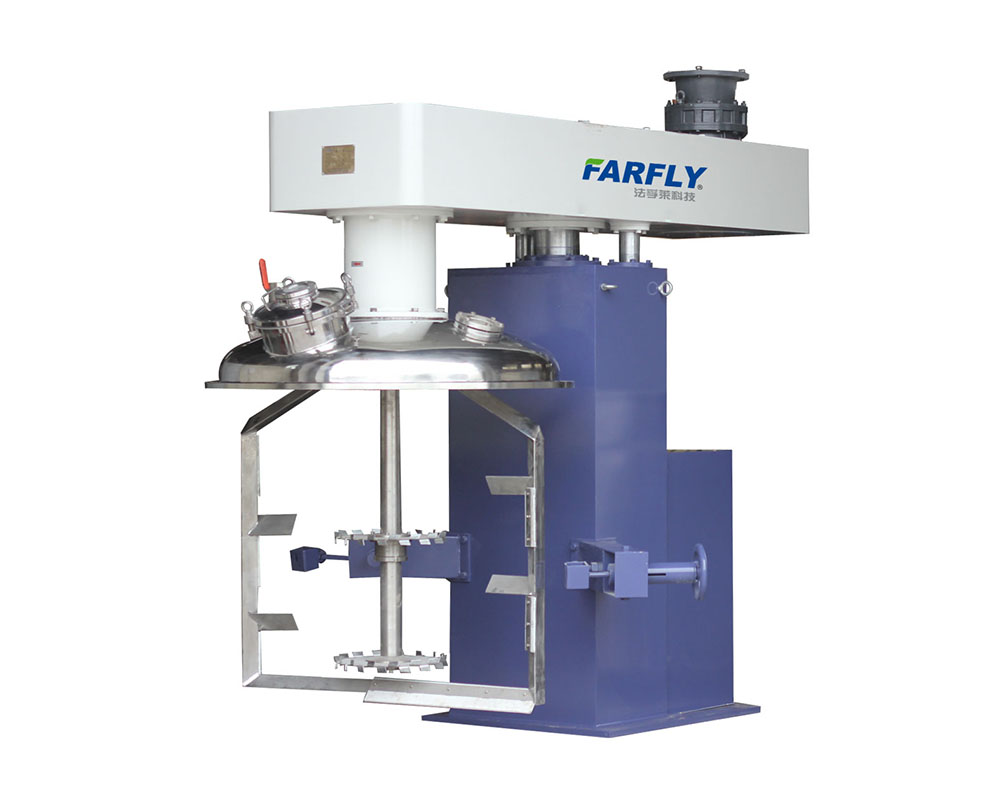
The FDT combines a low-speed scraper agitator with a high-speed disperser. The outer scraping action promotes bulk circulation and removes material from the vessel wall, while the high-speed dispersing disc works in the central mixing zone to accelerate wetting, dispersion and homogenization.
Low-Speed Scraper Agitator
Promotes overall material circulation and continuously returns wall-adhering material to the active mixing zone through PTFE scraping action.
High-Speed Disperser
Generates strong shear around the dispersing disc to break down agglomerates, incorporate powders and fillers, and improve dispersion uniformity.
Key Design Features of the FDT Agitator
The FDT is built around a configurable low-speed agitator, high-speed dispersing system and stable lifting structure. Agitator type, dispersing disc and drive mode can be selected around viscosity, density and formulation behavior.
Suitable Materials & Processing Conditions
The FDT is designed for formulations that benefit from simultaneous wall scraping, bulk circulation and high-speed dispersion. It is especially relevant where higher viscosity or solids loading makes a single mixing action less effective.
Epoxy Adhesives
Supports circulation and dispersion of resin systems containing fillers, powders and functional additives.
Polyurethane Adhesives
Suitable for formulations requiring controlled mixing, wall scraping and optional vacuum processing.
Anaerobic Adhesives
Helps combine liquid components and solid thickening materials while supporting consistent distribution through the batch.
Sealants
Suitable for viscous and filled sealant systems requiring simultaneous material turnover and high-speed dispersion.
Coatings & Printing Inks
Applicable to pigment- and filler-containing systems where circulation and dispersion need to occur in the same vessel.
Wall Putty & High-Solid Compounds
Designed for high-solid-content formulations where wall adhesion and reduced natural circulation can become process limitations.
When Should You Choose an FDT Concentric Double Shaft Agitator?
The FDT is most useful when the process needs wall scraping, overall material turnover and stronger local dispersion at the same time rather than relying on one shaft to perform every mixing function.
High-Solid Mixing Needs Stronger Turnover
The low-speed frame or half-frame agitator keeps the bulk material moving while the high-speed disperser works on powders, fillers and agglomerates.
Wall Adhesion Is Affecting Mixing Uniformity
The PTFE scraper continuously returns material from the vessel wall to the active mixing zone, reducing stagnant wall layers during processing.
Your Process Needs Flexible Dispersion Control
Frame style, dispersing disc, fixed or variable-speed drive and vacuum operation can be selected around the formulation and required mixing result.
FDT Concentric Double Shaft Agitator Technical Specifications
Standard model data provides a starting point for equipment selection. Final configuration should be confirmed according to viscosity, density, solids loading, batch size and the required mixing or dispersion result.
| Parameter / Model | FDT-150 | FDT-300 | FDT-500 | FDT-1000 | FDT-1500 |
|---|---|---|---|---|---|
| Tank Capacity | 150 L | 300 L | 500 L | 1000 L | 1500 L |
| Mixer Motor | 4 kW | 5.5 kW | 7.5 kW | 11 kW | 15 kW |
| Mixer Speed | 50 rpm | 40 rpm | 25 rpm | 25 rpm | 25 rpm |
| Dissolver Motor | 11 kW | 15 kW | 22 kW | 37 kW | 55 kW |
| Dissolver Speed | 1500 rpm | 1500 rpm | 1500 rpm | 1500 rpm | 1500 rpm |
* Specifications above are standard reference data from FARFLY. Final equipment configuration should be confirmed against the actual formulation and process requirement.
Available FDT Agitator Configurations
The FDT can be configured around material viscosity, formulation behavior, dispersion target and vessel-handling requirements rather than relying on one fixed mixing arrangement.
Typical FDT Mixing & Dispersion Workflow
The exact sequence depends on the formulation, but a typical adhesive or high-solid batch may move through the following stages.
Actual sequence, speed setting and process time depend on formulation, solids loading, viscosity and required final properties.
What We Need to Select Your FDT Agitator
Tank capacity alone is not enough to select the correct FDT model. Material behavior, solids loading and dispersion objectives should be considered together before the final drive and agitator configuration is confirmed.
Configure the FDT Around Your Production Process
FARFLY can evaluate the FDT configuration around formulation behavior and production needs, from agitator and dispersing disc selection to speed control, vacuum and vessel handling.
Formulation Review
Viscosity, density, solids loading and material behavior provide the starting point for equipment selection.
Agitator Selection
Frame or half-frame mixing can be matched to the required bulk circulation and material turnover.
Dispersion Selection
Single, double or Neumann dispersing discs can be evaluated against the required dispersion result.
Process Control
Fixed or variable-speed operation and optional vacuum can be selected around the production requirement.
Tank Handling
Hydraulic lift and swing support single- or multi-tank production layouts and easier vessel access.
FDT Concentric Double Shaft Agitator FAQ
Common questions when evaluating the FDT for adhesives, coatings, inks, sealants and other viscous or high-solid formulations.