How Does the FQLF Powerful Dispersing Machine Work?
Filled adhesives and sealants need more than high rotor speed. The complete batch must circulate through the vessel while powders, pigments and functional additives repeatedly enter the high-shear zones.
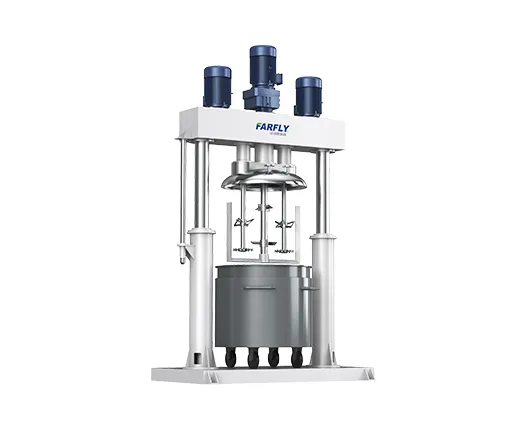
In the FQLF, one agitator revolves around the vessel axis while two independently driven shafts rotate around their own axes. These combined motions generate complex material trajectories, strong shearing and rubbing, and continuous redistribution throughout the batch.
Planetary Circulation & Scraping
The revolving assembly moves material through the vessel while the scraper cleans the wall and bottom and folds adhering material back into the batch.
Twin High-Speed Dispersion
Two high-speed shafts create intensive local shear to support powder wetting, agglomerate breakup and uniform distribution of fillers and additives.
Key Design Features of the FQLF Disperser
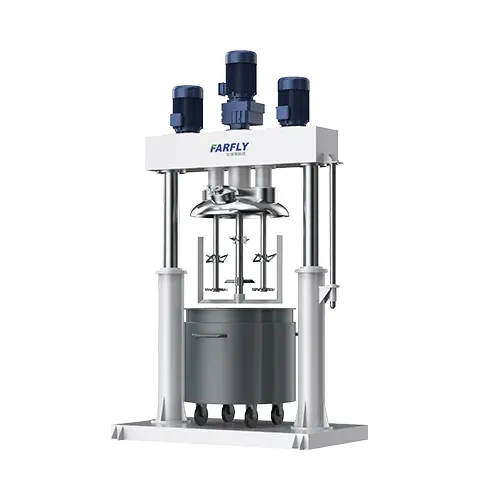
The FQLF integrates planetary movement, high-speed dispersion, vacuum processing and hydraulic vessel access. Agitator form and speed range can be configured around the material's flow behavior and the required final dispersion result.
Adhesive & Sealant Applications
The FQLF is intended for formulations that need intensive dispersion, continuous scraping, controlled circulation and optional vacuum deaeration in the same production vessel.
Glass Adhesives
Designed for mixing and dispersing filled glass-bonding formulations where uniformity and low air content are important.
Silicone Sealants
Supports incorporation of fillers and additives while wall scraping and vacuum help control material consistency and entrained air.
Structural Adhesives
Combines bulk turnover with localized high shear for demanding, filled structural-bonding systems.
Weather-Resistant Sealants
Suitable for production processes requiring consistent additive distribution, scraping and controlled vacuum mixing.
Black Adhesives & Sealants
High-speed dispersion supports uniform distribution of pigments and solid components throughout the batch.
Anti-Mold Adhesives
Helps distribute functional additives consistently while the planetary action limits stagnant areas.
When Should You Choose an FQLF Powerful Disperser?
Choose the FQLF when one mixing mechanism cannot provide enough circulation, scraping, dispersion and deaeration for the complete batch.
Your Batch Needs More Than One Flow Pattern
Planetary revolution moves material through the vessel while two self-rotating shafts create targeted high-shear working zones.
Wall or Bottom Build-Up Reduces Uniformity
The mountain-shaped scraper returns adhering material to the mixing zone and helps reduce unmixed regions around the vessel surface.
Air Removal Is Part of the Quality Target
Sealed construction supports vacuum operation to remove entrained air and improve the density and appearance of the finished material.
FQLF Powerful Dispersing Machine Specifications
The standard FQLF range covers 600 to 5000 L. Use the data below as a model-selection reference; final power, agitator arrangement and vessel details should be confirmed against the actual process.
| Parameter / Model | FQLF-600 | FQLF-1500 | FQLF-3000 | FQLF-5000 |
|---|---|---|---|---|
| Capacity | 600 L | 1500 L | 3000 L | 5000 L |
| Planetary Drive Power | 15 kW | 22 kW | 30 kW | 45 kW |
| High-Speed Drive Power | 22 kW × 2 | 30 kW × 2 | 37 kW × 2 | 55 kW × 2 |
| Planetary Speed | 0–40 rpm | 0–40 rpm | 0–40 rpm | 0–40 rpm |
| High-Speed Shaft Speed | 0–1450 rpm | 0–1000 rpm | 0–1000 rpm | 0–1000 rpm |
* Standard reference data from FARFLY. The two high-speed motors are shown as rated power × 2. Final specifications may change with material characteristics and customized configuration.
Available FQLF Machine Configurations
The mixing tools and process controls can be matched to material rheology, dispersion target, air-removal requirement and the operating sequence of your production line.
Typical Adhesive & Sealant Production Workflow
The exact sequence depends on the formulation, but the FQLF can combine charging, wetting, dispersion, vacuum deaeration and final homogenization in one vessel.
Actual addition order, speed, temperature, vacuum level and mixing time must be determined from the formulation and quality target.
What We Need to Configure Your FQLF
Capacity alone does not determine the right disperser. Provide the following process data so FARFLY can evaluate model size, power, mixing-tool arrangement and optional systems.
Configure the FQLF Around Your Production Process
FARFLY can evaluate the complete process from material behavior and dispersion target to vacuum, vessel handling and production-scale requirements.
Formulation Review
Viscosity, density, solids loading and temperature establish the equipment-selection basis.
Mixing-Tool Selection
Blade, frame, butterfly or impeller arrangements can be matched to the required circulation and shear.
Drive & Speed Selection
Motor power and VFD ranges are evaluated against batch load and required dispersion intensity.
Vacuum Process Design
Sealing, vacuum feeding and deaeration requirements can be incorporated into the process configuration.
Production Integration
Hydraulic lifting, movable-vessel handling and downstream discharge can be aligned with the plant layout.
FQLF Powerful Dispersing Machine FAQ
Common questions from adhesive and sealant manufacturers evaluating a planetary dispersing system.