How Does the FYL Hydraulic Discharging Machine Work?
Highly viscous material may not flow from a mixer vessel under gravity. Manual removal is slow, labor-intensive and can leave a large amount of usable product on the vessel wall.
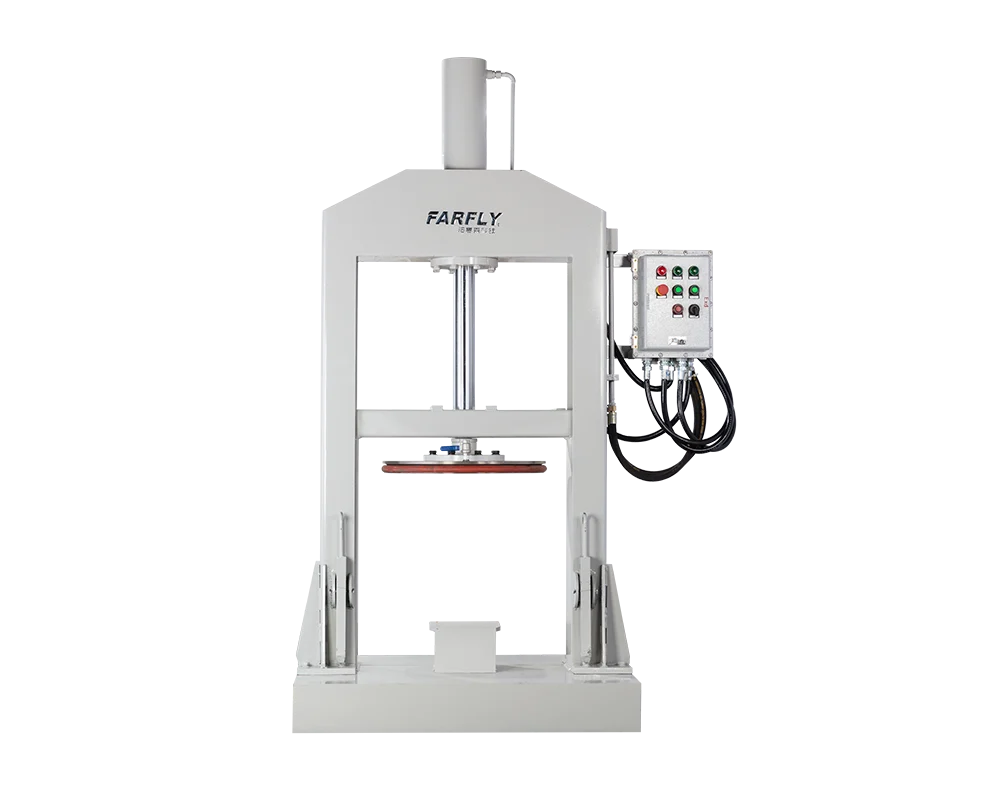
The FYL positions a hydraulic pressure plate above the material vessel. As the plate descends, a vessel-matched sealing ring contacts the wall and forms a closed working space. Hydraulic force then pushes the material toward the selected outlet for controlled transfer to filling or downstream equipment.
Hydraulic Pressure Plate
Applies stable downward pressure to move non-flowing or slow-flowing material out of the vessel.
Vessel-Matched Sealing Ring
Maintains close contact with the vessel wall to form a sealed space and guide material toward the outlet.
Key Design Features of the FYL Discharge Press
The FYL is built around a rigid frame, hydraulic lifting and pressing system, vessel-matched pressure plate and configurable material outlet.
High-Viscosity Material Discharge Applications
The FYL is intended for materials that do not discharge efficiently by gravity and need positive hydraulic force for transfer, filling or packaging.
High-Viscosity Adhesives
Transfers dense adhesive batches from movable mixer vessels to downstream filling or packaging.
Silicone & Structural Sealants
Applies positive pressure to materials that resist gravity discharge after planetary mixing.
High-Viscosity Inks
Supports controlled removal and transfer of paste-like ink formulations from matched vessels.
Resins & Polymer Compounds
Suitable for dense resin systems requiring sealed, pressure-assisted discharge.
Filled Industrial Pastes
Helps move highly filled products whose solids loading limits natural flow.
Mixer-to-Filling Transfer
Connects planetary mixing with manual filling, metered filling or the next processing stage.
When Should You Choose an FYL Hydraulic Discharger?
The FYL is most useful when discharge—not mixing—is the production bottleneck and a viscous batch cannot be transferred efficiently from the mixer vessel.
Gravity Discharge Is Too Slow
The ram plate supplies positive pressure to move material that otherwise remains in the vessel.
Manual Removal Creates Labor and Waste
The vessel-matched sealing plate helps direct more product to the outlet and reduces manual scraping.
The Mixer Must Connect to Filling
The discharge system can feed manual filling, packaging equipment or another downstream process.
FYL Hydraulic Discharging Machine Specifications
Standard published models cover vessel diameters from 900 to 1200 mm. Final plate and sealing dimensions must match the actual material vessel.
| Model | Motor Power | Tank Diameter | Pressure Plate Diameter | Maximum Lift |
|---|---|---|---|---|
| FYL-900 | 4 kW | 900 mm | 900 mm | 1150 mm |
| FYL-1000 | 4 kW | 1000 mm | 1000 mm | 1150 mm |
| FYL-1100 | 5.5 kW | 1100 mm | 1100 mm | 1250 mm |
| FYL-1200 | 5.5 kW | 1200 mm | 1100 mm | 1250 mm |
* Standard reference data from FARFLY. Note that the published FYL-1200 pressure plate diameter is 1100 mm while its tank diameter is 1200 mm; confirm the intended vessel and sealing arrangement before quotation. Final configuration depends on vessel dimensions, material behavior, required flow and outlet design.
Available FYL Discharge System Configurations
Cylinder structure, vessel arrangement, sealing plate and outlet route can be configured around the mixer vessel and downstream filling process.
Typical High-Viscosity Discharge Workflow
A typical mixer-to-filling workflow may use the following steps.
Actual pressing pressure, speed and discharge rate depend on viscosity, thixotropy, temperature, outlet size, transfer distance and downstream back pressure.
What We Need to Configure Your FYL
Tank diameter alone is not enough. Provide the following information so pressing force, plate, seal and outlet design can be evaluated together.
Match the FYL to Your Mixer and Filling Process
FARFLY can evaluate the discharger as part of the complete high-viscosity production line rather than as an isolated press.
Material Review
Viscosity, thixotropy, density and temperature establish the discharge requirement.
Vessel Matching
Plate and sealing geometry are matched to actual vessel dimensions.
Hydraulic Selection
Cylinder arrangement and pressing duty are evaluated against material resistance.
Outlet Design
Bottom or plate-pipeline discharge is selected around the downstream connection.
Line Integration
Mixer vessel handling, filling, transfer and cleaning are aligned with the plant workflow.
FYL Hydraulic Discharging Machine FAQ
Common questions when selecting a hydraulic ram press for adhesives, sealants, inks and resins.