
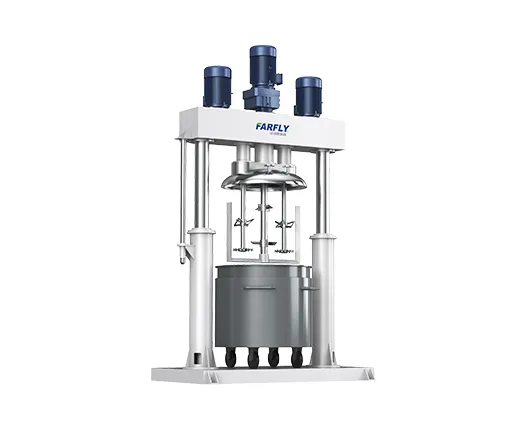
FQLF Powerful Dispersing Machine

An industrial planetary dispersing machine engineered for demanding adhesive and sealant production. Three independent drives combine planetary circulation, twin high-speed dispersion and continuous wall-and-bottom scraping to mix, disperse and deaerate difficult formulations in one closed vessel.
Three independently driven mixing actions
Standard capacities from 600 to 5000 L
High-speed dispersion up to 1450 rpm
Vacuum, hydraulic lift & VFD control
Mixing Principle
Planetary + High Shear
Complex circulation with intensive dispersion
Drive System
3 Independent Motors
One planetary drive plus two high-speed drives
Working Capacity
600–5000 L
Four standard models for scale-up
Process Options
Vacuum / VFD
Hydraulic lifting and movable vessel design
Mixing Principle

How Does the FQLF Powerful Dispersing Machine Work?

Filled adhesives and sealants need more than high rotor speed. The complete batch must circulate through the vessel while powders, pigments and functional additives repeatedly enter the high-shear zones.

In the FQLF, one agitator revolves around the vessel axis while two independently driven shafts rotate around their own axes. These combined motions generate complex material trajectories, strong shearing and rubbing, and continuous redistribution throughout the batch.

A mountain-shaped scraper follows the planetary path to remove material from the vessel wall and bottom, returning it to the active mixing zone and reducing stagnant areas.
Three Actions in One Closed Vessel Each drive performs a distinct role while the batch is continuously recirculated.
01

Planetary Circulation & Scraping

The revolving assembly moves material through the vessel while the scraper cleans the wall and bottom and folds adhering material back into the batch.

02

Twin High-Speed Dispersion

Two high-speed shafts create intensive local shear to support powder wetting, agglomerate breakup and uniform distribution of fillers and additives.

Machine Design

Key Design Features of the FQLF Disperser

The FQLF integrates planetary movement, high-speed dispersion, vacuum processing and hydraulic vessel access. Agitator form and speed range can be configured around the material's flow behavior and the required final dispersion result.
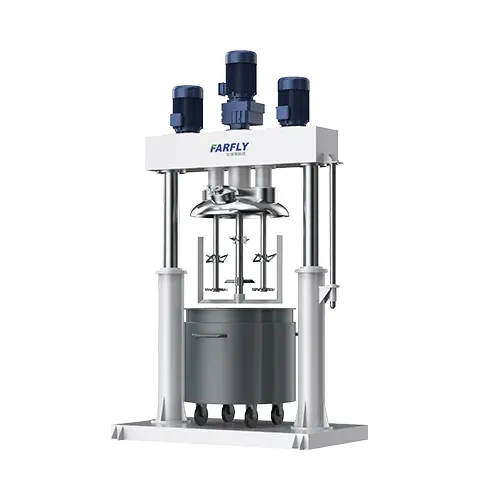
FQLF planetary powerful disperser machine structure
01
Three Independent Drives Independent motors allow the planetary and high-speed functions to be controlled for different process stages.
02
Planetary Motion The revolving assembly repeatedly carries material across the vessel and through the high-shear working zones.
03
Mountain-Shaped Scraper Continuously removes material from the vessel wall and bottom to reduce dead zones and improve batch uniformity.
04
Sealed Vacuum Processing Closed-vessel construction supports vacuum feeding and deaeration when the formulation requires lower air content.
05
Hydraulic Head Lifting The mixing head lifts hydraulically so the vessel can be moved for charging, discharge, cleaning and changeover.
06
Configurable Agitator Forms Multi-layer blade, frame, butterfly and impeller arrangements can be evaluated according to material characteristics.
Applications & Process Fit

Adhesive & Sealant Applications

The FQLF is intended for formulations that need intensive dispersion, continuous scraping, controlled circulation and optional vacuum deaeration in the same production vessel.

01 / GLASS BONDING

Glass Adhesives

Designed for mixing and dispersing filled glass-bonding formulations where uniformity and low air content are important.

02 / SILICONE

Silicone Sealants

Supports incorporation of fillers and additives while wall scraping and vacuum help control material consistency and entrained air.

03 / CONSTRUCTION

Structural Adhesives

Combines bulk turnover with localized high shear for demanding, filled structural-bonding systems.

04 / WEATHERPROOFING

Weather-Resistant Sealants

Suitable for production processes requiring consistent additive distribution, scraping and controlled vacuum mixing.

05 / SPECIALTY

Black Adhesives & Sealants

High-speed dispersion supports uniform distribution of pigments and solid components throughout the batch.

06 / FUNCTIONAL

Anti-Mold Adhesives

Helps distribute functional additives consistently while the planetary action limits stagnant areas.

Especially Suitable When Your Process Requires Final machine selection should be based on actual formulation behavior, not application name alone.
01Planetary circulation plus intensive local shear
02High powder, pigment or filler loading
03Continuous wall-and-bottom scraping
04Vacuum feeding or batch deaeration
05Independent variable-speed process control
06Movable-vessel production and cleaning access
Mixer Selection Logic

When Should You Choose an FQLF Powerful Disperser?

Choose the FQLF when one mixing mechanism cannot provide enough circulation, scraping, dispersion and deaeration for the complete batch.

01

Your Batch Needs More Than One Flow Pattern

Planetary revolution moves material through the vessel while two self-rotating shafts create targeted high-shear working zones.

02

Wall or Bottom Build-Up Reduces Uniformity

The mountain-shaped scraper returns adhering material to the mixing zone and helps reduce unmixed regions around the vessel surface.

03

Air Removal Is Part of the Quality Target

Sealed construction supports vacuum operation to remove entrained air and improve the density and appearance of the finished material.

Need to confirm process fit? Share your formulation type, viscosity profile, density, solids loading, batch volume and target fineness so the agitator form, power and speed range can be evaluated before quotation.
Technical Data

FQLF Powerful Dispersing Machine Specifications

The standard FQLF range covers 600 to 5000 L. Use the data below as a model-selection reference; final power, agitator arrangement and vessel details should be confirmed against the actual process.

Parameter / Model FQLF-600 FQLF-1500 FQLF-3000 FQLF-5000
Capacity 600 L 1500 L 3000 L 5000 L
Planetary Drive Power 15 kW 22 kW 30 kW 45 kW
High-Speed Drive Power 22 kW × 2 30 kW × 2 37 kW × 2 55 kW × 2
Planetary Speed 0–40 rpm 0–40 rpm 0–40 rpm 0–40 rpm
High-Speed Shaft Speed 0–1450 rpm 0–1000 rpm 0–1000 rpm 0–1000 rpm

* Standard reference data from FARFLY. The two high-speed motors are shown as rated power × 2. Final specifications may change with material characteristics and customized configuration.

Configuration Options

Available FQLF Machine Configurations

The mixing tools and process controls can be matched to material rheology, dispersion target, air-removal requirement and the operating sequence of your production line.

ComponentAvailable ConfigurationSelection Basis
Agitator FormMulti-Layer / Frame / Butterfly / ImpellerSelected according to viscosity, flow behavior and required circulation.
Drive ArrangementThree Independent MotorsSeparates planetary movement from the two high-speed dispersing functions.
Speed ControlVariable-Frequency ControlAllows speed adjustment across charging, wetting, dispersion and finishing stages.
Scraping SystemWall + Bottom ScraperReturns adhering material to the active mixing zone and limits dead areas.
Vacuum SystemAvailableSelected for vacuum feeding, reduced air incorporation and deaeration.
Lifting SystemHydraulic Head LiftProvides access for movable-vessel charging, discharge, cleaning and maintenance.
Working Capacity600 / 1500 / 3000 / 5000 LMatched to working batch volume, density, production output and scale-up plan.
Typical Process

Typical Adhesive & Sealant Production Workflow

The exact sequence depends on the formulation, but the FQLF can combine charging, wetting, dispersion, vacuum deaeration and final homogenization in one vessel.

01
Liquid ChargingBase liquids, resins or polymers are introduced into the vessel.
02
Powder IncorporationFillers, pigments and additives are added under controlled circulation.
03
Planetary DispersionThe three drives combine circulation, scraping and intensive high-speed shear.
04
Vacuum DeaerationVacuum is applied when required to remove entrained air from the batch.
05
Finish & DischargeFinal homogenization is completed before the vessel moves to discharge or the next process stage.

Actual addition order, speed, temperature, vacuum level and mixing time must be determined from the formulation and quality target.

Machine Selection

What We Need to Configure Your FQLF

Capacity alone does not determine the right disperser. Provide the following process data so FARFLY can evaluate model size, power, mixing-tool arrangement and optional systems.

Product & FormulationDescribe the adhesive or sealant type and the main raw-material groups.
Viscosity ProfileProvide starting, peak and final viscosity, including test temperature when available.
Batch CapacitySpecify working volume or batch weight and the required batches per shift.
Density & SolidsShare density and powder, pigment or filler loading to estimate drive demand.
Dispersion TargetState target fineness, uniformity, particle size or other acceptance criteria.
Vacuum & TemperatureConfirm required vacuum level, heating/cooling needs and allowable process temperature.
Cleaning & DischargeExplain changeover frequency, cleaning method and downstream transfer arrangement.
Engineering Support

Configure the FQLF Around Your Production Process

FARFLY can evaluate the complete process from material behavior and dispersion target to vacuum, vessel handling and production-scale requirements.

01

Formulation Review

Viscosity, density, solids loading and temperature establish the equipment-selection basis.

02

Mixing-Tool Selection

Blade, frame, butterfly or impeller arrangements can be matched to the required circulation and shear.

03

Drive & Speed Selection

Motor power and VFD ranges are evaluated against batch load and required dispersion intensity.

04

Vacuum Process Design

Sealing, vacuum feeding and deaeration requirements can be incorporated into the process configuration.

05

Production Integration

Hydraulic lifting, movable-vessel handling and downstream discharge can be aligned with the plant layout.

FAQ

FQLF Powerful Dispersing Machine FAQ

Common questions from adhesive and sealant manufacturers evaluating a planetary dispersing system.
What is an FQLF powerful dispersing machine?
The FQLF is a closed planetary mixing and dispersing system with three independent drives. One assembly revolves around the vessel axis while two shafts rotate around their own axes, combining material circulation, scraping and intensive dispersion.
What products can the FQLF process?
Typical applications include glass adhesives, silicone sealants, structural adhesives, weather-resistant sealants, black adhesives and anti-mold adhesive formulations. Final suitability depends on the actual formulation and quality target.
What capacities are available?
The standard FARFLY FQLF range includes 600 L, 1500 L, 3000 L and 5000 L models.
Why does the FQLF use three motors?
Independent motors drive the planetary function and the two high-speed shafts. This allows the different mixing actions to work together while their speeds are matched to each stage of the process.
How does the scraper reduce mixing dead zones?
The mountain-shaped scraper follows the revolution path and continuously removes material adhering to the vessel wall and bottom, folding it back into the active mixing area.
Can the FQLF mix under vacuum?
Yes. The sealed vessel can be used with a vacuum system for vacuum feeding and deaeration, helping reduce entrained air in the finished batch.
Which agitator forms can be supplied?
Depending on material characteristics, the mixer can be configured with multi-layer blade, frame, butterfly or impeller-type mixing tools.
What information is needed for a quotation?
Provide product type, working batch capacity, viscosity, density, solids loading, target fineness or uniformity, temperature, vacuum requirement, cleaning method and expected production output.
Scroll to Top

Get A Free Quote Now !

Contact Form Demo
If you have any questions, please do not hesitate to contact us.