How Does the FDL Double Shaft Mixer Work?
High-viscosity formulations need both bulk material movement and localized shear. If material does not circulate effectively, a high-speed disperser may work intensively around the disc while material farther from the active zone moves more slowly.
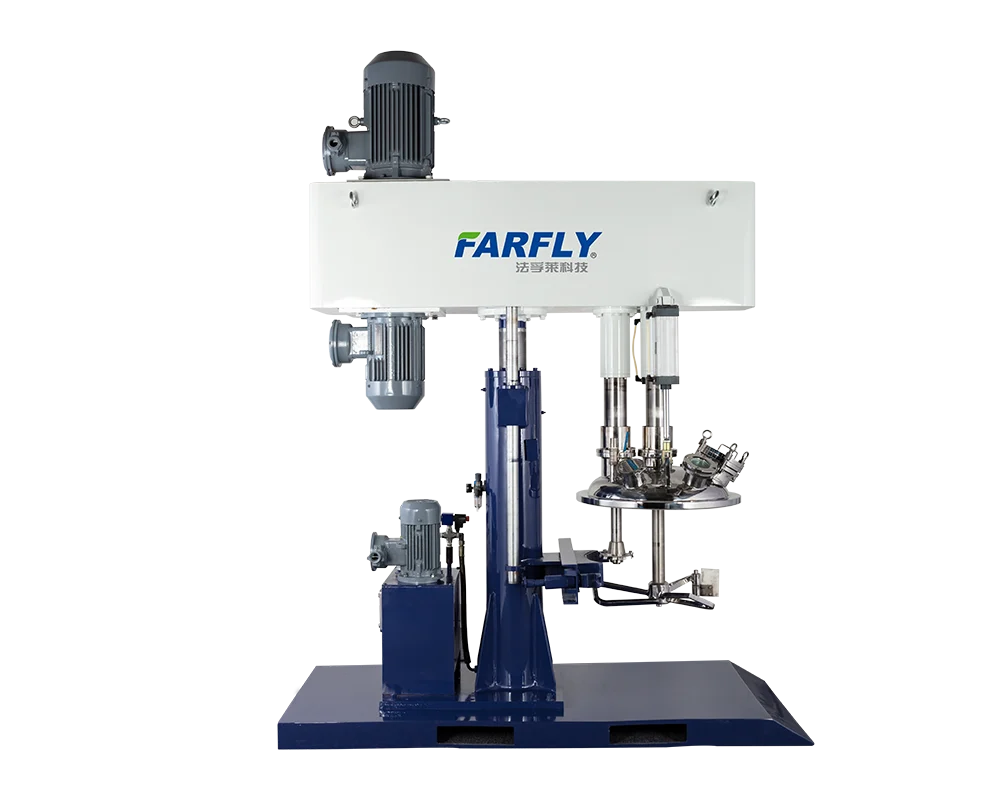
The FDL addresses both functions with two independently driven shafts: a low-speed scraper agitator moves the overall batch, while a high-speed dispersing shaft works on powders, fillers and agglomerates.
Low-Speed Scraper Agitator
Creates continuous bulk circulation throughout the vessel while PTFE scrapers return wall-adhering material to the active mixing zone.
High-Speed Dispersing Shaft
Generates intensive shear around the dispersing disc to wet out powders, break down agglomerates and distribute fillers and additives.
Key Machine Design for Mixing & Dispersion
The FDL is built around two independently driven mixing functions and a vessel-handling system designed for viscous production. The final arrangement can be selected according to material behavior and process requirements.

Suitable Materials & Processing Conditions
The FDL Double Shaft Mixer is intended for formulations that need simultaneous material turnover and high-speed dispersion, especially as increasing viscosity reduces natural circulation inside the vessel.
Epoxy Adhesives
For incorporating resins, fillers, functional powders and additives into medium- to high-viscosity adhesive formulations.
Polyurethane Adhesives
Supports controlled material circulation and dispersion in viscous resin systems containing fillers and additives.
Acrylic Adhesives
Suitable where resin systems require simultaneous blending, filler incorporation and high-speed dispersion.
Silicone Adhesives & Sealants
Supports continuous material turnover in viscous silicone-based formulations containing powders, fillers and additives.
Structural Adhesives & Sealants
For filled formulations where both overall circulation and localized dispersion are required during processing.
Coatings, Inks & Putties
Additional applications include viscous pigment- or filler-containing coating, ink, putty and polymer systems.
When Should You Choose an FDL Double Shaft Mixer?
The FDL is most useful when the process needs more than high-speed dispersion alone. Its second shaft is intended to maintain bulk material movement while the disperser works locally at higher shear.
Mixing + Dispersion Are Both Required
Choose a double shaft arrangement when the formulation requires overall circulation together with high-speed dispersion of powders, fillers or additives.
Viscosity Limits Natural Material Turnover
The low-speed scraper agitator keeps viscous material moving through the vessel while the high-speed disperser works in the active shear zone.
A Single High-Speed Disperser Is Not Enough
For more viscous formulations, strong local shear may not provide enough bulk circulation. The additional low-speed shaft supports overall turnover.
FDL Double Shaft Mixer Technical Specifications
Standard model data provides a starting point for equipment selection. Final motor power, agitator structure and process configuration should be confirmed according to the actual formulation and production requirement.
| Parameter / Model | FDL-600 | FDL-900 | FDL-1000 | FDL-1200 |
|---|---|---|---|---|
| Tank Capacity | 150 L | 500 L | 600 L | 900 L |
| High-Speed Power | 7.5–11 kW | 18.5–22 kW | 22–37 kW | 30–55 kW |
| Low-Speed Power | 4–4.5 kW | 7.5–15 kW | 11–30 kW | 11–37 kW |
| High-Speed Blade Diameter | 200 mm | 250 mm | 280 mm | 330 mm |
| Low-Speed Mixing Device Diameter | 570 mm | 860 mm | 960 mm | 1160 mm |
| High-Speed Shaft | 1500 rpm | 1500 rpm | 1500 rpm | 1500 rpm |
| Low-Speed Shaft | 90–120 rpm | 60–120 rpm | 120 rpm | 120 rpm |
| Max. Up / Down Range | 700 mm | 950 mm | 1000 mm | 1100 mm |
| Dimensions (L × W × H) | 1750 × 1250 × 2350 mm | 2420 × 1400 × 3106 mm | 2800 × 1700 × 3250 mm | 2800 × 1700 × 3250 mm |
* Specifications are standard reference data. Final equipment selection may change according to viscosity, density, formulation, batch size, mixing objective and site conditions.
Available FDL Mixer Configurations
Mixing components, speed control and vessel handling can be selected around material viscosity, dispersion target and production requirements.
Typical Double Shaft Mixing Workflow
A typical adhesive or filled formulation may move through the following stages. The actual sequence depends on formulation and production requirements.
Actual mixing sequence and processing time depend on formulation, viscosity, filler loading and required final properties.
What We Need to Select Your FDL Mixer
Capacity alone is not enough to select a double shaft mixer. Material behavior and the required processing result affect motor power, agitator structure, dispersing configuration and vessel arrangement.
Integrate the FDL Into Your Adhesive Production Process
The FDL can be supplied as standalone mixing equipment or considered together with material handling, transfer, discharge, filling and packaging requirements when planning a broader adhesive production process.
Raw Material Feeding
Liquids, resins, powders and fillers are prepared and introduced according to the formulation sequence.
FDL Double Shaft Mixing
Low-speed circulation and high-speed dispersion are combined in the main mixing stage.
Vacuum / Transfer
Vacuum and transfer arrangements can be evaluated according to material and downstream process needs.
Discharge / Filling
Finished material can move to discharge or filling equipment according to the production layout.
Packaging
Downstream packaging equipment can be considered when a more complete production line is required.
Double Shaft Mixer FAQ
Common questions when evaluating the FDL mixer for adhesives, coatings and other high-viscosity formulations.