How Does the FXJ Planetary Mixer Work?
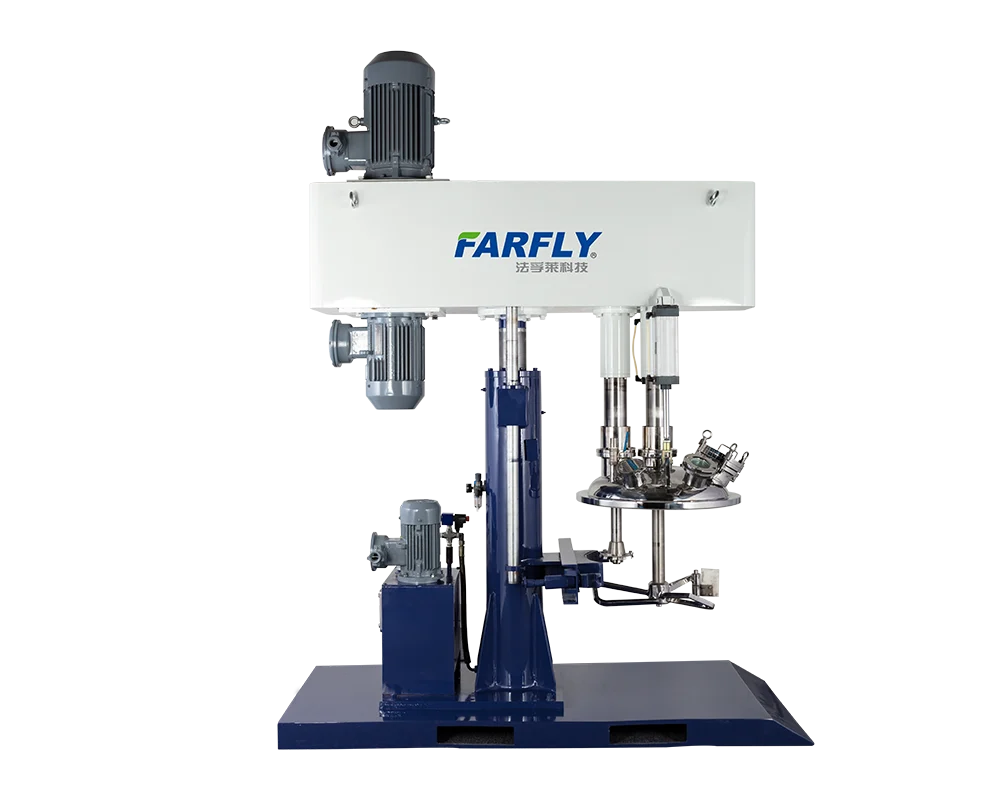
In high-viscosity batches, a conventional agitator may move material only near the blade. The FXJ uses two planetary mixing blades that rotate around their own axes while travelling around a common central axis close to the vessel wall.
This compound motion repeatedly carries material from the vessel perimeter toward the center. As the planetary carrier completes each revolution, the blades sweep through the full mixing area, supporting rapid blending, kneading and homogenization.
Blade Self-Rotation
Each blade rotates around its own axis to fold, shear and knead material in the local working zone.
Planetary Revolution
The blade assembly revolves around the vessel axis, sweeping material from the wall toward the center.
Key Design Features of the FXJ Planetary Mixer
The FXJ combines planetary mixing with sealed vacuum operation, configurable low-speed blades, controlled heating and a lifting structure for vessel access and batch changeover.
.png)
Materials & Processes for the FXJ Mixer
The FXJ is designed for mixing duties where complete material turnover, kneading, sealed processing or temperature control matters more than high-speed particle-size reduction.
Acrylic Adhesives
Supports powder incorporation, high-viscosity polymer blending, temperature-controlled reaction and vacuum deaeration.
Polyamide Adhesives
Suitable for controlled melt blending where uniform mixing and stable thermal management are important.
Viscous Sealant Compounds
Planetary circulation and vacuum operation help mix dense, filled materials while limiting entrained air.
Powder & Granule Blending
The sweeping blade path repeatedly redistributes dry or partially wetted solids across the vessel.
Resin & Polymer Compounds
Supports blending and reaction processes that require controlled temperature and full-batch circulation.
Dense Industrial Formulations
Intended for formulations where density and viscosity reduce natural flow around conventional agitators.
When Should You Choose an FXJ Planetary Mixer?
The FXJ is a strong fit when low-speed planetary coverage, kneading and controlled processing are more important than the high tip speed of a dispersing disc.
Conventional Agitation Leaves Unmixed Regions
The twin blades travel across the full vessel instead of working around a fixed shaft location.
Your Process Needs Mixing Plus Kneading
Planetary blade action supports incorporation and folding of materials whose viscosity or density limits free circulation.
Vacuum and Temperature Affect Product Quality
Closed-vessel processing, vacuum and multiple heating options support controlled reactions and lower air content.
FXJ Planetary Mixer Technical Specifications
Standard models cover 2 to 1000 L working volume. Scroll horizontally on smaller screens to review vessel dimensions, power, speeds, lift stroke and the published vacuum range.
| Model | Vessel Size (Dia. × Depth) | Full Volume | Working Volume | Motor Power | Blade Self-Rotation | Orbital / Scraping Speed | Lift Stroke | Vacuum* |
|---|---|---|---|---|---|---|---|---|
| FXJ-2L | Φ180 × 120/150 mm | 3 / 3.8 L | 2 L | 0.37–0.75 kW | 0–100 rpm | 0–60 rpm | 220 mm | -0.098–0.08 MPa |
| FXJ-5L | Φ240/288 × 180 mm | 8 / 11.7 L | 5 L | 0.55–1.5 kW | 0–100 rpm | 0–60 rpm | 270 mm | -0.098–0.08 MPa |
| FXJ-100L | Φ600 × 460/500 mm | 130 / 140 L | 100 L | 4–11 kW | 0–100 rpm | 0–60 rpm | 560 mm | -0.098–0.08 MPa |
| FXJ-200L | Φ720/750 × 650 mm | 265 / 287 L | 200 L | 7.5–15 kW | 0–80 rpm | 0–50 rpm | 750 mm | -0.098–0.08 MPa |
| FXJ-500L | Φ1000 × 380 mm | 650 L | 500 L | 15–37 kW | 0–60 rpm | 0–40 rpm | 930 mm | -0.098–0.08 MPa |
| FXJ-1000L | Φ1250 × 1000 mm | 1227 L | 1000 L | 30–55 kW | 0–50 rpm | 0–30 rpm | 1100 mm | -0.098–0.08 MPa |
* The vacuum value is reproduced from FARFLY's published table and should be confirmed during technical review. Vessel dimensions containing two values represent published configuration variants. Final specifications depend on the selected blade, material load and process requirements.
Available FXJ Planetary Mixer Configurations
Blade form, drive power, thermal system and vessel arrangement can be selected around the formulation, production scale and required batch sequence.
Typical Planetary Mixing Workflow
A typical adhesive, resin or high-viscosity batch may use the following sequence. Addition order and process settings must be adapted to the actual formulation.
Actual speed, temperature, vacuum, addition order and cycle time depend on formulation behavior and final quality requirements.
What We Need to Select Your FXJ Mixer
Provide the following process data so the working volume, motor power, blade type, vacuum and thermal configuration can be reviewed together.
Configure the FXJ Around Your Mixing Process
FARFLY can evaluate the planetary mixer around material rheology, batch scale, mixing target and process-control requirements.
Formulation Review
Viscosity, density, solids loading and thermal behavior establish the selection basis.
Blade Selection
Frame, paddle or helical arrangements are evaluated against circulation and kneading requirements.
Drive Selection
Motor power and speed ranges are matched to working volume and material load.
Thermal & Vacuum Design
Heating method, temperature control and vacuum requirements are integrated into the process configuration.
Vessel Handling
Lift stroke, vessel access, cleaning and discharge are aligned with the production layout.
FXJ Planetary Mixer FAQ
Common questions when evaluating the FXJ for powders, adhesives, resins and other viscous or dense formulations.