How Does the FXDJ Double Planetary Mixer Work?
High-viscosity formulations often need two different energy inputs. Planetary blades must keep the complete batch moving and kneading, while a high-speed disperser applies stronger local shear to powders, fillers and agglomerates.
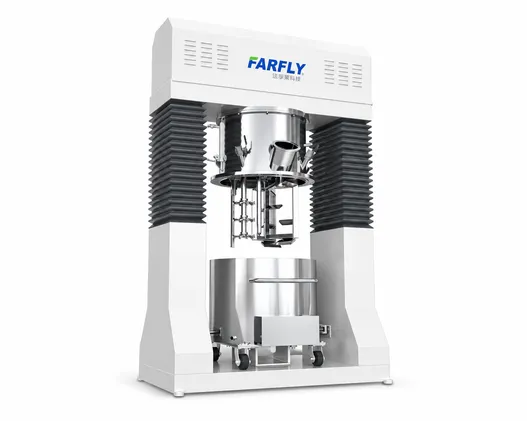
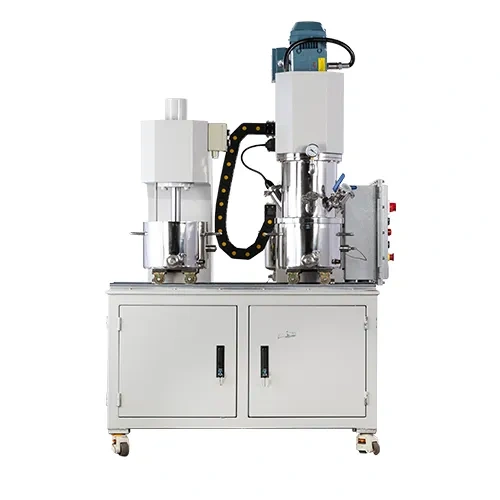
In the FXDJ, the planetary mixing assembly rotates and revolves through the vessel. One or two high-speed dispersing units can work within the batch to strengthen cutting, wetting and dispersion. A scraper travels with the planetary carrier and continuously returns wall-adhering material to the active mixing zone.
Planetary Mixing & Kneading
The low-speed blades rotate and revolve to fold material, create bulk circulation and sweep the complete vessel.
High-Speed Dispersion
The dispersing unit delivers stronger local shear for powder wetting, agglomerate breakup and additive distribution.
Key Design Features of the FXDJ Mixer
The FXDJ integrates planetary mixing, high-speed dispersion, scraping, vacuum processing, thermal control and hydraulic lifting in a configurable production platform.
High-Viscosity Mixing & Dispersion Applications
The FXDJ is especially relevant where a formulation needs planetary turnover and high-speed dispersion during the same batch, with optional vacuum and thermal processing.
Epoxy Adhesives
Supports resin, filler and functional-additive incorporation where both kneading and dispersion are required.
Polyurethane Adhesives
Closed processing, controlled mixing and vacuum deaeration support moisture- and air-sensitive formulations.
Silicone Adhesives & Sealants
Planetary turnover and high-speed shear help incorporate fillers into viscous silicone-based materials.
Acrylic Adhesives
Suitable for powder addition, polymer blending, reaction and deaeration under controlled process conditions.
Electronic Pastes
Supports mixing of dense solid-liquid systems where uniform additive distribution and low air content are important.
Filled Chemical Compounds
Applicable to solid-solid, solid-liquid and liquid-liquid processing requiring mixing, shearing and dispersion.
When Should You Choose an FXDJ Planetary Power Mixer?
Choose the FXDJ when low-speed planetary mixing alone cannot provide the dispersion intensity required for powders, fillers or agglomerates in a viscous batch.
Your Formulation Needs Kneading and Dispersion
Planetary blades handle bulk movement while the high-speed unit works on incorporation and agglomerate breakup.
Wall Build-Up Affects Batch Uniformity
The planetary scraper continuously removes adhering material and returns it to the working zone.
Air, Moisture or Temperature Must Be Controlled
Vacuum, heating and cooling options support deaeration, volatile removal and controlled processing.
FXDJ Double Planetary Mixer Technical Specifications
FARFLY publishes 15 standard FXDJ models. Scroll horizontally on smaller screens to compare planetary mixing power, revolution/rotation speed, dispersion system and auxiliary power.
| Model | Mixing Power | Revolution / Rotation | Dispersion Power | Dispersion Speed | Lift Power | Vacuum Pump Power |
|---|---|---|---|---|---|---|
| FXDJ-2 | 1.5 kW | 0–90 / 230 rpm | 1.5 kW | 0–2000 rpm | 0.75 kW | 0.37 kW |
| FXDJ-5 | 1.5 kW | 0–65 / 170 rpm | 1.5 kW | 0–2000 rpm | 1.5 kW | 0.37 kW |
| FXDJ-10 | 2.2 kW | 0–65 / 170 rpm | 3 kW | 0–2000 rpm | 1.5 kW | 0.55 kW |
| FXDJ-20 | 3 kW | 0–65 / 170 rpm | 4 kW | 0–1500 rpm | 1.5 kW | 0.55 kW |
| FXDJ-30 | 4 kW | 0–65 / 170 rpm | 4 kW | 0–1500 rpm | 1.5 kW | 0.55 kW |
| FXDJ-50 | 5.5 kW | 0–65 / 170 rpm | 7.5 kW | 0–1500 rpm | 1.5 kW | 1.5 kW |
| FXDJ-100 | 7.5 kW | 0–65 / 170 rpm | 11 kW | 0–1500 rpm | 1.5 kW | 1.5 kW |
| FXDJ-200 | 11 kW | 0–65 / 170 rpm | 18.5 kW | 0–1500 rpm | 2.2 kW | 2.2 kW |
| FXDJ-300 | 15 kW | 0–65 / 170 rpm | 22 kW | 0–1500 rpm | 2.2 kW | 2.2 kW |
| FXDJ-500 | 22 kW | 0–30 / 98 rpm | 30 kW | 0–1500 rpm | 3 kW | 4 kW |
| FXDJ-650 | 30 kW | 0–30 / 98 rpm | 37 kW | 0–1500 rpm | 3 kW | 4 kW |
| FXDJ-850 | 37 kW | 0–30 / 98 rpm | 45 kW | 0–1500 rpm | 3 kW | 4 kW |
| FXDJ-1000 | 45 kW | 0–30 / 98 rpm | 55 kW | 0–1500 rpm | 3 kW | 7.5 kW |
| FXDJ-1300 | 55 kW | 0–30 / 98 rpm | 55 kW | 0–1500 rpm | 3 kW | 7.5 kW |
| FXDJ-1500 | 75 kW | 0–30 / 98 rpm | 75 kW | 0–1500 rpm | 3 kW | 7.5 kW |
* Standard reference data from FARFLY. The published table does not separately state vessel working volume; model numbers should not be treated as confirmed capacity without technical review. Final power and speed configuration depends on viscosity, density, solids loading and process target.
Available FXDJ Mixer Configurations
The planetary mixing system, disperser, vacuum package and thermal controls can be matched to the formulation and required production sequence.
Typical Planetary Mixing & Dispersion Workflow
The exact sequence depends on the formulation, but an adhesive or filled-compound batch may follow these stages.
Actual speed, temperature, vacuum, mixing time and addition order depend on formulation behavior and quality criteria.
What We Need to Configure Your FXDJ
Provide the following process data so planetary power, dispersion power, vacuum, thermal control and model size can be evaluated together.
Configure the FXDJ Around Your Production Process
FARFLY can evaluate the combined planetary and dispersing system around material behavior and the required finished-product properties.
Formulation Review
Viscosity, density, solids loading and thermal behavior establish the selection basis.
Planetary Selection
Mixing power and blade action are matched to circulation and kneading demand.
Dispersion Selection
Disperser power, speed and quantity are evaluated against the required shear and scale.
Vacuum & Thermal Design
Vacuum, heating and cooling requirements are integrated with the batch sequence.
Production Integration
Hydraulic lifting, vessel handling, discharge and cleaning are aligned with the plant layout.
FXDJ Double Planetary Mixer FAQ
Common questions when evaluating the FXDJ for adhesives, sealants, pastes and other viscous filled formulations.