
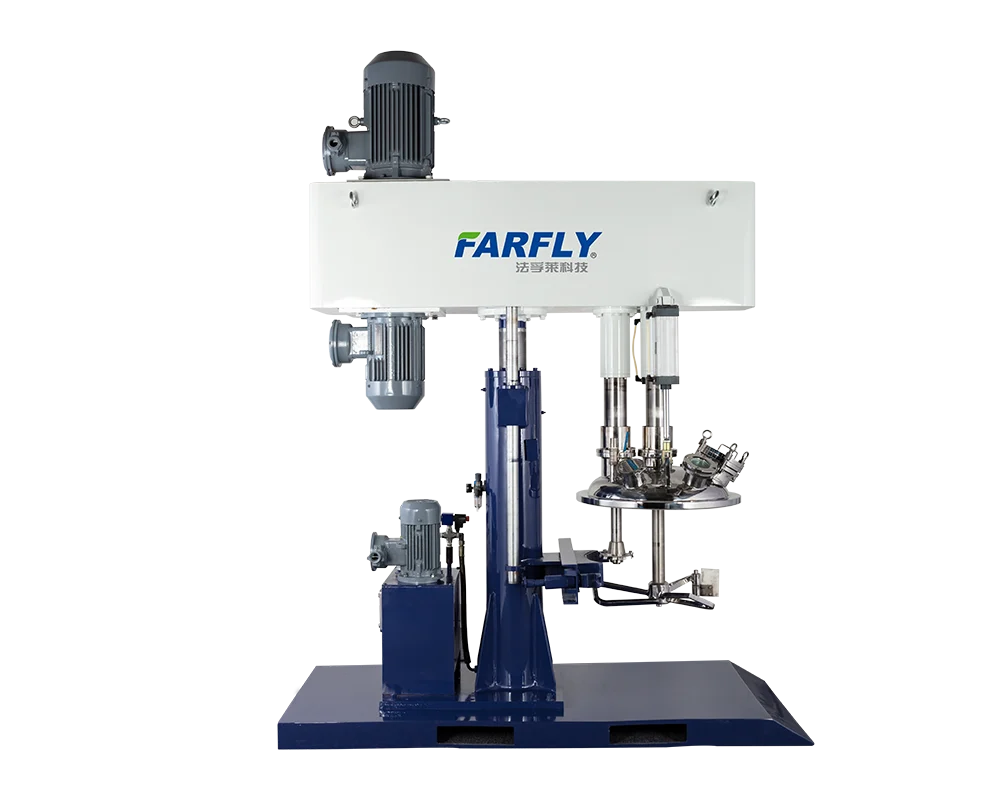
FXJ Planetary Mixer

An industrial planetary mixing system for dissolving, blending, kneading and reacting materials from powders to high-viscosity and high-density compounds. Two mixing blades rotate on their own axes while revolving around the vessel, creating full-batch circulation in a sealed, temperature-controlled process.
Twin-blade planetary rotation + revolution
Working volumes from 2 to 1000 L
Self-rotation speed up to 100 rpm
Vacuum, hydraulic lift & heating options
Mixing Principle
Planetary Motion
Twin blades rotate and revolve together
Working Volume
2–1000 L
Laboratory through production scale
Mixing Functions
Blend / Knead / React
For powders, viscous and dense materials
Process Control
Vacuum / Temperature
Multiple heating methods available
Mixing Principle

How Does the FXJ Planetary Mixer Work?

In high-viscosity batches, a conventional agitator may move material only near the blade. The FXJ uses two planetary mixing blades that rotate around their own axes while travelling around a common central axis close to the vessel wall.

This compound motion repeatedly carries material from the vessel perimeter toward the center. As the planetary carrier completes each revolution, the blades sweep through the full mixing area, supporting rapid blending, kneading and homogenization.

Rotation provides local mixing around each blade; revolution carries those working zones through the complete vessel so powders and viscous materials are repeatedly redistributed.
Two Motions Working Together The planetary path combines local blade action with complete vessel coverage.
01

Blade Self-Rotation

Each blade rotates around its own axis to fold, shear and knead material in the local working zone.

02

Planetary Revolution

The blade assembly revolves around the vessel axis, sweeping material from the wall toward the center.

Machine Design

Key Design Features of the FXJ Planetary Mixer

The FXJ combines planetary mixing with sealed vacuum operation, configurable low-speed blades, controlled heating and a lifting structure for vessel access and batch changeover.

FXJ planetary mixer industrial machine structure and control system
01
Twin Planetary Mixing BladesCompound rotation and revolution create three-dimensional circulation throughout the vessel.
02
Multiple Blade FormsFrame, paddle and helical or twist-frame blades can be selected according to material rheology.
03
Wall Scraping ActionThe planetary path carries material away from the vessel wall and redirects it toward the central mixing zone.
04
Sealed Vacuum OperationSupports mixing in a closed environment and removal of entrained air and selected volatile components.
05
Flexible Heating MethodsElectric, steam, hot-water or thermal-oil heating can be paired with intelligent temperature control.
06
Hydraulic Lifting SystemModel-dependent lifting strokes support vessel positioning, cleaning and production changeover.
Applications & Process Fit

Materials & Processes for the FXJ Mixer

The FXJ is designed for mixing duties where complete material turnover, kneading, sealed processing or temperature control matters more than high-speed particle-size reduction.

01 / ADHESIVES

Acrylic Adhesives

Supports powder incorporation, high-viscosity polymer blending, temperature-controlled reaction and vacuum deaeration.

02 / HOT MELT

Polyamide Adhesives

Suitable for controlled melt blending where uniform mixing and stable thermal management are important.

03 / SEALANTS

Viscous Sealant Compounds

Planetary circulation and vacuum operation help mix dense, filled materials while limiting entrained air.

04 / POWDERS

Powder & Granule Blending

The sweeping blade path repeatedly redistributes dry or partially wetted solids across the vessel.

05 / RESINS

Resin & Polymer Compounds

Supports blending and reaction processes that require controlled temperature and full-batch circulation.

06 / HIGH DENSITY

Dense Industrial Formulations

Intended for formulations where density and viscosity reduce natural flow around conventional agitators.

Especially Suitable When Your Process Requires Material behavior and final quality targets should determine mixer selection.
01Mixing from powder to viscous or dense compounds
02Three-dimensional planetary circulation
03Blending, kneading or reaction in one vessel
04Closed vacuum processing and deaeration
05Controlled heating or cooling stages
06Laboratory-to-production scale-up
Mixer Selection Logic

When Should You Choose an FXJ Planetary Mixer?

The FXJ is a strong fit when low-speed planetary coverage, kneading and controlled processing are more important than the high tip speed of a dispersing disc.

01

Conventional Agitation Leaves Unmixed Regions

The twin blades travel across the full vessel instead of working around a fixed shaft location.

02

Your Process Needs Mixing Plus Kneading

Planetary blade action supports incorporation and folding of materials whose viscosity or density limits free circulation.

03

Vacuum and Temperature Affect Product Quality

Closed-vessel processing, vacuum and multiple heating options support controlled reactions and lower air content.

Need intensive pigment or filler dispersion? If the process requires a high-speed dispersing disc as well as planetary mixing, ask FARFLY to evaluate a planetary power mixer configuration instead of selecting by capacity alone.
Technical Data

FXJ Planetary Mixer Technical Specifications

Standard models cover 2 to 1000 L working volume. Scroll horizontally on smaller screens to review vessel dimensions, power, speeds, lift stroke and the published vacuum range.

Model Vessel Size (Dia. × Depth) Full Volume Working Volume Motor Power Blade Self-Rotation Orbital / Scraping Speed Lift Stroke Vacuum*
FXJ-2LΦ180 × 120/150 mm3 / 3.8 L2 L0.37–0.75 kW0–100 rpm0–60 rpm220 mm-0.098–0.08 MPa
FXJ-5LΦ240/288 × 180 mm8 / 11.7 L5 L0.55–1.5 kW0–100 rpm0–60 rpm270 mm-0.098–0.08 MPa
FXJ-100LΦ600 × 460/500 mm130 / 140 L100 L4–11 kW0–100 rpm0–60 rpm560 mm-0.098–0.08 MPa
FXJ-200LΦ720/750 × 650 mm265 / 287 L200 L7.5–15 kW0–80 rpm0–50 rpm750 mm-0.098–0.08 MPa
FXJ-500LΦ1000 × 380 mm650 L500 L15–37 kW0–60 rpm0–40 rpm930 mm-0.098–0.08 MPa
FXJ-1000LΦ1250 × 1000 mm1227 L1000 L30–55 kW0–50 rpm0–30 rpm1100 mm-0.098–0.08 MPa

* The vacuum value is reproduced from FARFLY's published table and should be confirmed during technical review. Vessel dimensions containing two values represent published configuration variants. Final specifications depend on the selected blade, material load and process requirements.

Configuration Options

Available FXJ Planetary Mixer Configurations

Blade form, drive power, thermal system and vessel arrangement can be selected around the formulation, production scale and required batch sequence.

ComponentAvailable ConfigurationSelection Basis
Planetary BladesFrame / Paddle / Helical-Twist FrameMatched to viscosity, density, solids and required kneading action.
Speed ControlVariable SpeedSelected for charging, blending, reaction and finishing stages.
Vacuum ProcessSealed Vacuum DesignUsed when deaeration, volatile removal or isolation from contamination is required.
Heating MethodElectric / Steam / Hot Water / Thermal OilMatched to utility availability and the required temperature range.
Temperature ControlIntelligent ControllerSupports stable heating and temperature maintenance during processing.
Lifting SystemHydraulic LiftStroke is matched to model size and vessel-access requirements.
Working Volume2 / 5 / 100 / 200 / 500 / 1000 LSelected from batch volume, density, output and scale-up requirements.
Typical Process

Typical Planetary Mixing Workflow

A typical adhesive, resin or high-viscosity batch may use the following sequence. Addition order and process settings must be adapted to the actual formulation.

01
Material ChargingLiquids, powders, granules or resin components are introduced into the vessel.
02
Initial BlendingThe planetary blades establish circulation and begin incorporating the raw materials.
03
Kneading / ReactionRotation and revolution continue at controlled speed; heating can be applied when required.
04
Vacuum ProcessingThe sealed vessel supports deaeration and removal of selected volatile components.
05
Finish & DischargeThe batch is homogenized to the target condition before transfer or discharge.

Actual speed, temperature, vacuum, addition order and cycle time depend on formulation behavior and final quality requirements.

Mixer Selection

What We Need to Select Your FXJ Mixer

Provide the following process data so the working volume, motor power, blade type, vacuum and thermal configuration can be reviewed together.

Material & ProcessDescribe whether the batch requires dissolving, blending, kneading, reaction or deaeration.
Viscosity ProfileProvide starting, maximum and final viscosity with test temperature when available.
Working Batch SizeSpecify required working volume or batch weight and expected batches per shift.
Density & SolidsShare density and powder, granule or filler loading to evaluate drive demand.
Mixing TargetDefine uniformity, reaction endpoint, air-content or other acceptance criteria.
Temperature & VacuumConfirm heating/cooling range, available utilities and required vacuum level.
Vessel HandlingExplain charging, discharge, cleaning and movable-vessel requirements.
Engineering Support

Configure the FXJ Around Your Mixing Process

FARFLY can evaluate the planetary mixer around material rheology, batch scale, mixing target and process-control requirements.

01

Formulation Review

Viscosity, density, solids loading and thermal behavior establish the selection basis.

02

Blade Selection

Frame, paddle or helical arrangements are evaluated against circulation and kneading requirements.

03

Drive Selection

Motor power and speed ranges are matched to working volume and material load.

04

Thermal & Vacuum Design

Heating method, temperature control and vacuum requirements are integrated into the process configuration.

05

Vessel Handling

Lift stroke, vessel access, cleaning and discharge are aligned with the production layout.

FAQ

FXJ Planetary Mixer FAQ

Common questions when evaluating the FXJ for powders, adhesives, resins and other viscous or dense formulations.
What is an FXJ planetary mixer?
The FXJ is a twin-blade mixer in which both blades rotate on their own axes while revolving around a common axis inside the vessel. This compound motion provides full-area mixing for powders, viscous materials and dense formulations.
What working volumes are available?
The published standard range includes 2 L, 5 L, 100 L, 200 L, 500 L and 1000 L working-volume models.
What processes can the FXJ perform?
The FXJ is designed for dissolving, blending, mixing, kneading and selected reaction processes. Vacuum and temperature control can be integrated when required.
What is the difference between rotation and revolution?
Rotation is each blade turning around its own axis. Revolution is the blade assembly travelling around the vessel axis. Together, these motions move the mixing zones through the complete batch.
Can the FXJ operate under vacuum?
Yes. Its sealed design supports vacuum operation for deaeration, removal of selected volatile components and reduced exposure to external contamination.
Which blade types are available?
Published options include frame, paddle and helical or twist-frame low-speed blades. Final selection depends on viscosity, density and the required mixing action.
What heating methods can be supplied?
The FXJ can be configured for electric, steam, hot-water or thermal-oil heating with intelligent temperature control.
How do I select the correct FXJ model?
Start with working batch size, viscosity, density, solids loading, mixing or reaction target, temperature range, vacuum level, cleaning method and required production output.
Scroll to Top

Get A Free Quote Now !

Contact Form Demo
If you have any questions, please do not hesitate to contact us.